Social Media for UK Tradespeople: What Actually Gets You Work in 2026
Written by Tom Ellis · Senior Trades Editor
Last updated: July 2026
Quick Answer
For most UK tradespeople, Instagram and Facebook are the two platforms worth your time. Instagram works best for visual trades — bathroom fitters, landscapers, painters, tilers — where before-and-after photos generate genuine local interest. Facebook community groups are effective for all trades because local homeowners actively use them to ask for recommendations. TikTok can produce viral results but rarely reaches local customers. Paid social ads are almost never worth the investment until you have organic content working first.
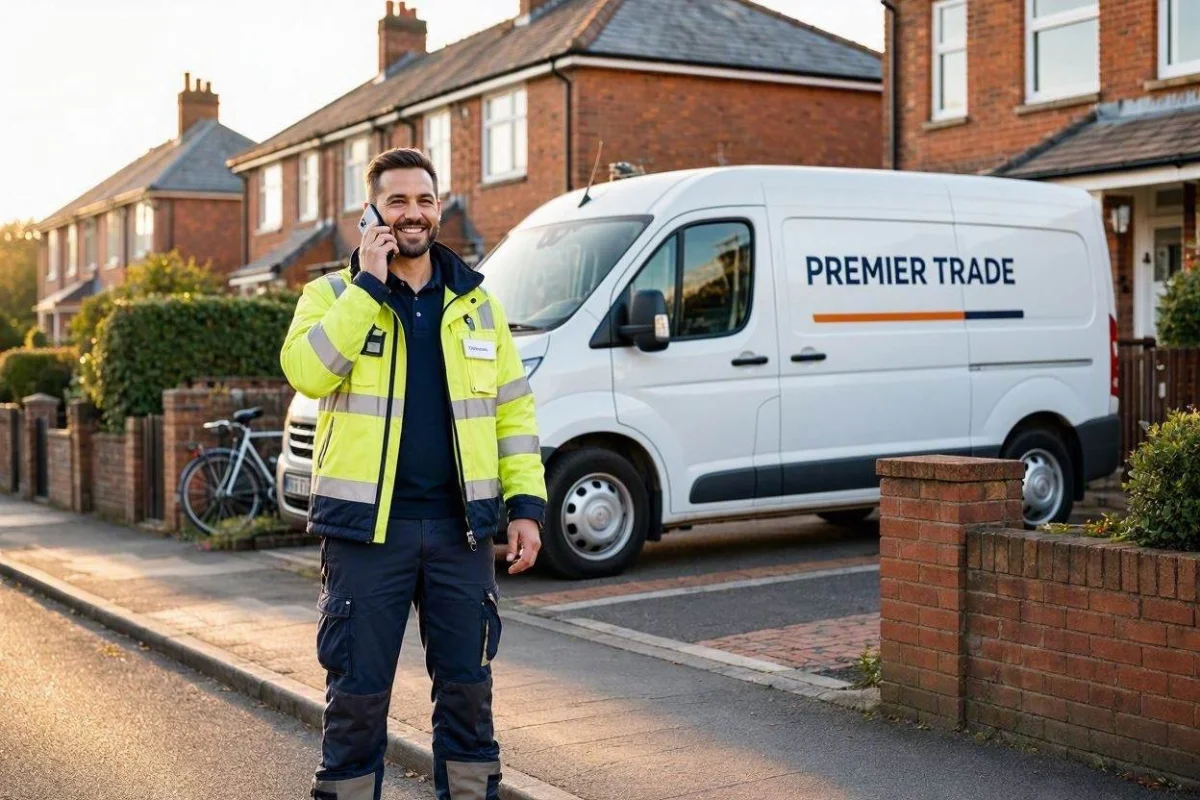
Social media is one of those topics where the advice tradespeople receive tends to come from marketers who have never hung a door or fitted a bathroom. The reality is more straightforward: certain platforms work for certain trades, the content that generates enquiries is simple to produce, and most of the fancy tactics you read about online are not necessary. This guide covers what actually moves the needle for UK tradespeople in 2026, based on what works in practice rather than what sounds good in theory. For broader marketing strategy, see our guide to how to get more customers as a UK tradesman.
Which Platform Is Right for Your Trade?
Not every platform is worth your time, and spreading yourself across all of them simultaneously is a reliable way to produce mediocre content everywhere and results nowhere. The starting point is to match your trade to the platform where the visual output of your work is most compelling, and where your target customers spend time. Different trades have genuinely different answers here, and a strategy that works brilliantly for a landscaper may do nothing for a gas engineer.
Instagram is the strongest platform for trades where the finished result is visually striking: bathroom fitters, kitchen fitters, landscapers, painters and decorators, tilers, and carpenters all see good engagement because before-and-after photos are inherently shareable. A newly tiled wet room or a freshly landscaped garden generates likes, saves, and follows from local accounts in a way that a new consumer unit simply does not. If your trade produces dramatic visual transformations, Instagram should be your primary platform.
Facebook is effective across a much wider range of trades because its community group structure puts you in front of local homeowners who are actively looking for recommendations, regardless of how photogenic your work is. Plumbers, electricians, gas engineers, roofers, and general builders all get real enquiries from Facebook groups even though their work is less visually exciting. The mechanism is different from Instagram: rather than building a following who see your content organically, you are positioning yourself to be found and recommended when someone asks "does anyone know a good [trade] in [area]?".
LinkedIn is worth considering if you are targeting commercial clients rather than homeowners: facilities managers, property developers, construction project managers, and procurement teams use LinkedIn actively. A LinkedIn profile that clearly states your trade, certifications, and the scale of commercial work you can handle can generate B2B enquiries that are not available through any consumer-facing platform. For sole traders doing primarily residential work, LinkedIn is a lower priority. TikTok is discussed separately below, but the short version is: it is worth experimenting with if you have the time, but it should not replace Instagram or Facebook as your primary focus.
Instagram: How to Use It as a Tradesperson
The single most effective Instagram content format for tradespeople is the before-and-after post. Take a photo of the space or job before you start work, and a photo of the same area once you have finished. Post them together — either as a side-by-side image or as a carousel where you swipe through — and write a short caption describing what you did, the location (town or city), and how long the job took. This format works because the transformation is immediately understandable to anyone who sees it, and it demonstrates your standard of work more convincingly than any amount of text.
Instagram Reels currently reach significantly more accounts than static posts because the platform's algorithm prioritises video content. A 15-to-30 second time-lapse of a job in progress — a bathroom being tiled, a garden being levelled and turfed, a room being painted — requires no editing skill beyond what is built into your phone's camera app and performs consistently well. You do not need music or captions on every Reel: a simple time-lapse with a brief text overlay naming your trade and location is enough. The trade-off is that Reels take a few minutes more to produce than a static photo, so find a balance that you can sustain.
Hashtags on Instagram serve a narrower purpose than most people think: in 2026 their role in growing your reach has diminished significantly compared to a few years ago, but they remain useful for one specific goal — local discoverability. Use a mix of your trade (for example, #LandscapeGardener, #BathroomFitter, #PainterDecorator) and your location (#ManchesterPlumber, #BristolBuilder, #LeedsElectrician). Keep it to five to ten hashtags per post — there is no evidence that stacking 30 hashtags improves reach. What matters far more is the quality of the content and the consistency of your posting schedule.
Your Instagram bio needs to do a specific job: tell someone who finds your profile what trade you are, where you work, and how to contact you. A bio that reads "Manchester bathroom fitter — full bathroom renovations — DM or call 07xxx xxxxxx" is more useful than one full of emojis and vague claims. Include a link to your website or your Google Business Profile. Switch your account to a Professional Account (it is free) to access basic analytics showing which posts reach the most people.
Facebook: Community Groups and Business Pages
Facebook community groups are one of the most underused marketing tools available to UK tradespeople. Almost every town and suburb has at least one active local Facebook group where homeowners ask for recommendations, and these groups produce genuine, warm leads. The typical post looks like this: "Can anyone recommend a good roofer in [area]? Need a repair done on my bay window." If you are a member of the group and someone in your trade recognises your name, they will tag you. If you are known in the group for being helpful, the admin or other members will recommend you. This costs nothing and produces direct enquiries.
To make this work, join the five to ten local community groups covering the areas you operate in. Read the group rules — many groups allow tradespeople to introduce themselves and post their services once a week, usually on a designated day. When you see someone asking for your trade, comment with your name, trade, and contact details. Keep it brief and friendly. Do not write a sales pitch: "Hi, I'm Dave, local plumber in [area], happy to have a look at it — give me a call on 07xxx" is more effective than two paragraphs about your qualifications and experience. Being visible and approachable is the goal.
A Facebook Business page is worth setting up alongside your personal profile because it gives you a dedicated space to post your work, collect Facebook reviews, and run ads if you ever decide to try them. The page also appears in Facebook's own search results when local users look for a tradesperson. Set up the page with your business name, trade category, service area, phone number, website link, and opening hours. Post your completed jobs to the Business page in the same way you would on Instagram: photos of the work, a short description, and your location. Link the Business page in your bio on any other platforms you use.
When you spot the classic "does anyone know a good...?" post in a local group, respond promptly — the first few comments get the most visibility. If a previous customer has tagged you, respond and thank them publicly. If a customer leaves a Facebook review, respond to it with a brief thank you. These small interactions build a public reputation over time that is visible to anyone who looks you up, and Facebook's local search surfaces businesses with active pages and recent reviews above those with dormant ones.
TikTok: When It Is Worth Your Time (and When It Is Not)
TikTok has produced some genuinely large audiences for tradespeople — there are UK builders, tilers, and plumbers with hundreds of thousands of followers. However, it is important to understand what TikTok's algorithm actually does before you invest time in it. Unlike Facebook groups or local Instagram hashtags, TikTok distributes content to interest-based audiences nationally and globally, not geographically. A time-lapse of a bathroom renovation that gets 50,000 views will mostly be watched by people in Birmingham, London, and Glasgow simultaneously — and the vast majority of those viewers are not potential customers for a sole trader working from one area.
The content that works well on TikTok from a tradespeople's perspective falls into a narrow category: dramatic transformations, satisfying process videos (tiling a large floor in 60 seconds, plastering a wall perfectly smooth), and educational content that explains what you do and why. A time-lapse of a complex job — a full loft conversion, a garden landscaping project from bare mud to finished lawn — can accumulate significant views because these formats are genuinely compelling to a broad audience. If you enjoy filming and the idea of building an audience appeals to you, TikTok is worth trying.
The honest assessment for most sole traders is this: TikTok is a significant time investment for uncertain local return. The effort required to produce good TikTok content — filming consistently, editing clips, staying on top of trends — is considerably higher than posting a job photo to Instagram. For a busy tradesperson who already has more work than they can handle, TikTok is probably not the best use of evenings. For a tradesperson who is trying to grow and has more time than jobs at the moment, it is worth experimenting with for two to three months to see whether it generates local enquiries in your specific area and trade.
One practical middle ground: post your Instagram Reels to TikTok at the same time with minimal extra effort. The formats are compatible, and repurposing content across both platforms costs only a few extra minutes per post. If a particular piece of content performs unusually well on TikTok, that is a signal to produce more of the same. If TikTok generates consistent local enquiries after two to three months, invest more time. If it does not, redirect that effort to Instagram and Facebook where the local targeting is more reliable.
Converting Social Followers into Google Reviewers
Google reviews are more valuable to a tradesperson's business than social media followers, because they directly influence your ranking in local search results and convert sceptical new customers in a way that Instagram likes do not. The good news is that your social media presence can be used as a pipeline for collecting Google reviews from satisfied customers, even if those customers would not have left a review unprompted.
The most effective method is straightforward: when a customer comments positively on one of your Instagram or Facebook posts ("Wow, this looks amazing, great job!"), reply publicly to thank them and then send them a direct message with your Google review link. Something like "So glad you're happy with it! If you get a chance, a quick Google review would really help the business — here's the link." Customers who have already made the effort to comment publicly are significantly more likely to leave a review than customers who receive a cold text message after the job.
You can also use your social media posts to nudge all followers toward Google reviews periodically. Once a month, post a straightforward call to action: a photo of recent work with a caption along the lines of "If I've done work for you recently and you're happy with it, a Google review helps more than you might think — link in bio." Many followers will have used your services but never thought to leave a review. A gentle public reminder, combined with a direct link in your bio, removes the friction that prevents most satisfied customers from following through.
For more detail on why Google reviews matter and how to build them systematically, see our guide to Checkatrade and review platforms for 2026. Building reviews across Google, Checkatrade, and your Facebook Business page simultaneously gives you a strong review footprint that wins customer trust at every touchpoint in the buying decision.
How to Photograph Your Work Properly on a Phone
The quality of your photos has a direct impact on how professional your social media presence looks, and therefore on how seriously potential customers take your business. You do not need a professional camera or a photographer. Modern smartphones produce more than adequate results if you follow a few basic principles. The most important is lighting: natural light is always better than artificial light. Photograph completed work during the day with the lights off and the curtains or blinds open if it is an interior job, or wait for a bright but overcast day for exterior work. Direct sunlight creates harsh shadows; overcast days produce flat, even light that makes spaces look larger and cleaner.
Before shots matter as much as after shots for the impact of your content, but most tradespeople forget to take them. Make it a habit at the start of every job: before you move anything or start work, take three or four photos of the existing space from different angles. Take the same angles again when you finish. The before-and-after format only works when the comparison is direct — the same viewpoint, the same lighting conditions. Keep the before shots in a folder on your phone so you can find them easily when the job is done.
Angles make a significant difference in interior spaces. For bathrooms, kitchens, and rooms, shoot from a corner of the room to capture as much depth as possible, with your back in the corner and the phone at chest or eye height. This wide-angle perspective makes a small bathroom look large and communicates the full scope of the work. For exterior work — driveways, gardens, roofing — shoot from a low angle looking up toward the property, or from the far end of a driveway looking back toward the house. Both angles create a sense of scale and quality.
Before posting, do a quick tidy: towels off the towel rail, tools out of frame, dust sheets removed, doors opened to let in light. A finished bathroom with a crumpled bag of grout in the corner looks less impressive than the exact same bathroom cleared of clutter. This takes 30 seconds and makes a measurable difference to the quality of the photo. Most phones have a basic editing mode that lets you increase brightness and contrast slightly after shooting — a small brightness boost is often enough to make an interior photo look substantially more professional.
Content Ideas That Take Minutes, Not Hours
One of the most common reasons tradespeople abandon their social media is that they run out of content ideas and fall into the trap of thinking every post needs to be a finished project photo. In reality, there are many types of content that are quick to produce, perform well, and give potential customers genuine insight into how you work. Job-in-progress shots are particularly effective: a photo of materials laid out before tiling begins, or scaffold going up around a roof, or a bathroom stripped back to the studwork, shows the scale and complexity of your work in a way that finished photos alone do not capture.
Customer testimonial screenshots work well because they provide social proof without requiring any additional effort from you beyond asking for and screenshotting a text or WhatsApp message. Ask customers if you can share their feedback publicly, screenshot their message (with their name visible if they consent, or with it cropped out if they prefer), and post it with a brief line about the job. These posts consistently generate engagement from other local followers who recognise the address or area mentioned in the testimonial.
Explaining what you do in simple terms is an underused content format that builds credibility without requiring visual content. A post that says "As a gas engineer, I get asked a lot about whether a combi boiler can heat a large house. Here's the honest answer..." followed by three bullet points of practical information positions you as knowledgeable and trustworthy. Homeowners who are planning future work will save this kind of post. It also demonstrates your expertise to people who have never heard of you before — which is exactly the audience you want to reach on social media.
Tool-of-the-week posts and "what I'm working on today" updates are quick to produce and humanise your business in a way that project showcases do not. A photo of your van loaded up at 7am with a one-line caption about the job ahead takes 30 seconds to post and reminds your local followers that you are active, busy, and available. The cumulative effect of regular low-effort posts is a social media presence that looks consistent and professional without requiring hours of content creation every week.
What Not to Do on Social Media
The fastest way to damage your social media presence is to argue with a customer publicly. Whether a negative comment appears on your Business page, in a local group, or under one of your posts, responding defensively or angrily is visible to every potential customer who sees the exchange. It does not matter if you are completely in the right: a tradesperson who argues publicly looks unprofessional to an outside observer. Keep all public responses calm, brief, and professional — something along the lines of "Sorry to hear you feel that way, please give me a call so we can resolve this." Then handle the actual dispute privately. This response looks far more reassuring to future customers than a detailed public defence.
Posting infrequently and then flooding your feed with ten posts in one day is worse than a consistent three-posts-a-week schedule, because social media algorithms reward regularity and penalise bursty behaviour. If you have a backlog of photos from recent jobs, space them out rather than posting them all at once. Meta Business Suite (free) lets you schedule posts in advance, so you can create a week's worth of content on a Sunday evening and have it post automatically throughout the week without any further effort.
Generic stock photos are worse than no photos at all. A picture of a smiling builder in a hard hat that you found online, or an AI-generated image of a pristine bathroom, tells potential customers nothing about your actual work and looks dishonest next to the real photos that other tradespeople are posting. If you do not have a photo for a specific post, write a text-based post instead. Authenticity is more valuable than polish on local social media, and real photos of real work you have done are more persuasive than any image you could source from elsewhere.
Do not copy content directly from other tradespeople's accounts, even if they are not in your area. If a customer recognises a photo they have seen elsewhere, or if another tradesperson calls it out, the reputational damage is significant and not worth any short-term convenience. Every piece of content on your social media should be your own work. This is also where the compounding value of a consistent posting habit becomes clear: tradespeople who post real photos of their own jobs consistently never run out of content, because they are producing new material every week.
Are Paid Social Ads Worth It for Tradespeople?
The honest answer is: almost never, until you have organic social media working and a clear understanding of your local market. Paid Facebook and Instagram ads for local trades are not as straightforward as the platform's "Boost post" button suggests. To get a decent return, you need to define your target audience precisely (location, age range, homeowner status), set a competitive daily budget, design a compelling ad with a clear call to action, and monitor performance over several weeks to optimise. Most tradespeople who try boosting a post for £5 a day see minimal results and conclude that paid social does not work. The real issue is usually poor targeting or a generic ad, not the platform itself.
When paid social does work for tradespeople, it tends to be for specific, high-value services with a defined target audience: bathroom renovations targeted at homeowners aged 35 to 65 within a 10-mile radius, or garden landscaping targeted at homeowners in affluent postcodes during spring and summer. These campaigns require a budget of at least £300 to £500 per month and several weeks of testing before the results are reliable. The cost per lead from a well-optimised Facebook campaign can be competitive with Checkatrade, but the setup time and ongoing management make it more suitable for tradespeople who are scaling a business than for sole traders in their first few years.
For most UK tradespeople, the marketing budget hierarchy before touching paid social ads should be: Google Business Profile (free, highest priority), a basic website (£10 to £20 per month, second priority), Checkatrade or a similar lead platform (£100 to £130 per month, third), and then paid advertising once those foundations are generating consistent enquiries. You can read our analysis of whether Checkatrade is worth the money in 2026 to help decide where to allocate your budget.
There is one scenario where paid social advertising makes sense even at an early stage: if you have a specific, time-sensitive offer — a seasonal service, a promotional rate for the next two weeks, availability opening up — a short burst of paid promotion to your existing followers and their local network can generate a surge of enquiries at low cost. This is different from running always-on campaigns: it uses paid reach strategically to amplify something specific rather than trying to generate awareness permanently.
Related guides
Frequently Asked Questions
How often should I post on social media as a tradesperson?
Three to four times a week is enough to build a consistent presence on Instagram or Facebook without burning out. Consistency matters far more than frequency: posting three times a week every week will outperform posting every day for a fortnight and then going silent for a month. The content does not need to be elaborate. A photo taken on your phone at the end of a job, with two or three sentences describing the work and the location, takes two minutes to post and is enough to keep your profile active and visible to local audiences. Use Meta Business Suite to schedule posts in batches if daily posting feels like too much.
Do I need to show my face on social media?
Showing your face helps, but it is not essential. Work photos, before-and-after shots, and job-in-progress content perform well without your face in them. However, tradespeople who do occasionally appear in their content — explaining a job, showing the scale of a project, or briefly introducing themselves — tend to build a more loyal local following faster. Customers hire people, not businesses, and seeing the person behind the work builds trust. If you are uncomfortable on camera, start with voiceover videos of your work rather than filming yourself directly, and add face-to-camera content gradually as you get more comfortable.
Can I automate my social media posting?
You can schedule posts in advance using tools such as Meta Business Suite (free for Facebook and Instagram) or Buffer. This is worth doing if you find yourself posting inconsistently because you are too busy during the week. However, be careful with fully automated content — stock photos, generic quotes, or AI-generated captions that could apply to any business in any location will not generate local trust or enquiries. The content that works for tradespeople is specific: a real job, a real location, a real result. Batch-create a week of posts on a Sunday evening and schedule them for automatic publication — that saves daily effort without sacrificing authenticity.
Is TikTok worth it for UK tradespeople?
TikTok works well for a narrow set of trades and content types: time-lapse transformations of complex jobs, satisfying tiling or plastering videos, and dramatic before-and-after reveals. These videos can accumulate tens of thousands of views. The problem is that TikTok's algorithm is national or global, not local, so most of those views will not come from potential customers in your area. For most tradespeople, the same time spent on Instagram Reels and local Facebook groups will generate more direct business. If you are already creating Reels for Instagram, post them to TikTok at the same time with no extra effort — but do not build TikTok at the expense of the platforms that reach local audiences more reliably.
Should I run paid ads on Facebook or Instagram?
Paid social advertising is rarely worth the investment until you have organic content working and a clear understanding of which posts generate enquiries. Paid Facebook and Instagram ads for local trades typically cost between £5 and £20 per lead at best, which is comparable to Checkatrade or Rated People but with significantly more setup and management time required. Most tradespeople will get a better return from their budget by investing in a stronger Google Business Profile, more Checkatrade reviews, or a basic website before touching paid social. The exception is short-term promotional campaigns to your existing followers, which can work well at relatively low cost.
Sleepless Tradesman
Quote, invoice and manage jobs — all in one app
Join thousands of UK tradespeople running their admin from their phone. Free to start, no card needed.
Send Professional Invoices the Same Day You Finish a Job
Social media builds awareness, but getting paid on time keeps the business running. Sleepless Tradesman generates professional PDF invoices in minutes — no templates to fiddle with, no spreadsheets. Try it free or see what the Pro plan includes.