How Much Does a New Roof Cost in the UK? [2026]
Written by Tom Ellis · Senior Trades Editor
Last updated: July 2026
Last updated: July 2026 · United Kingdom
Quick Answer
Last updated: July 2026 · United Kingdom
A full roof replacement in the UK costs approximately £3,000–5,500 for a mid-terrace house, £4,500–8,000 for a semi-detached, and £7,000–14,000 for a detached property in 2026. Labour typically accounts for 40–50% of the total, and scaffolding should be included in most quotes. Material choice — from felt through to natural slate — has the biggest impact on long-term cost and durability.
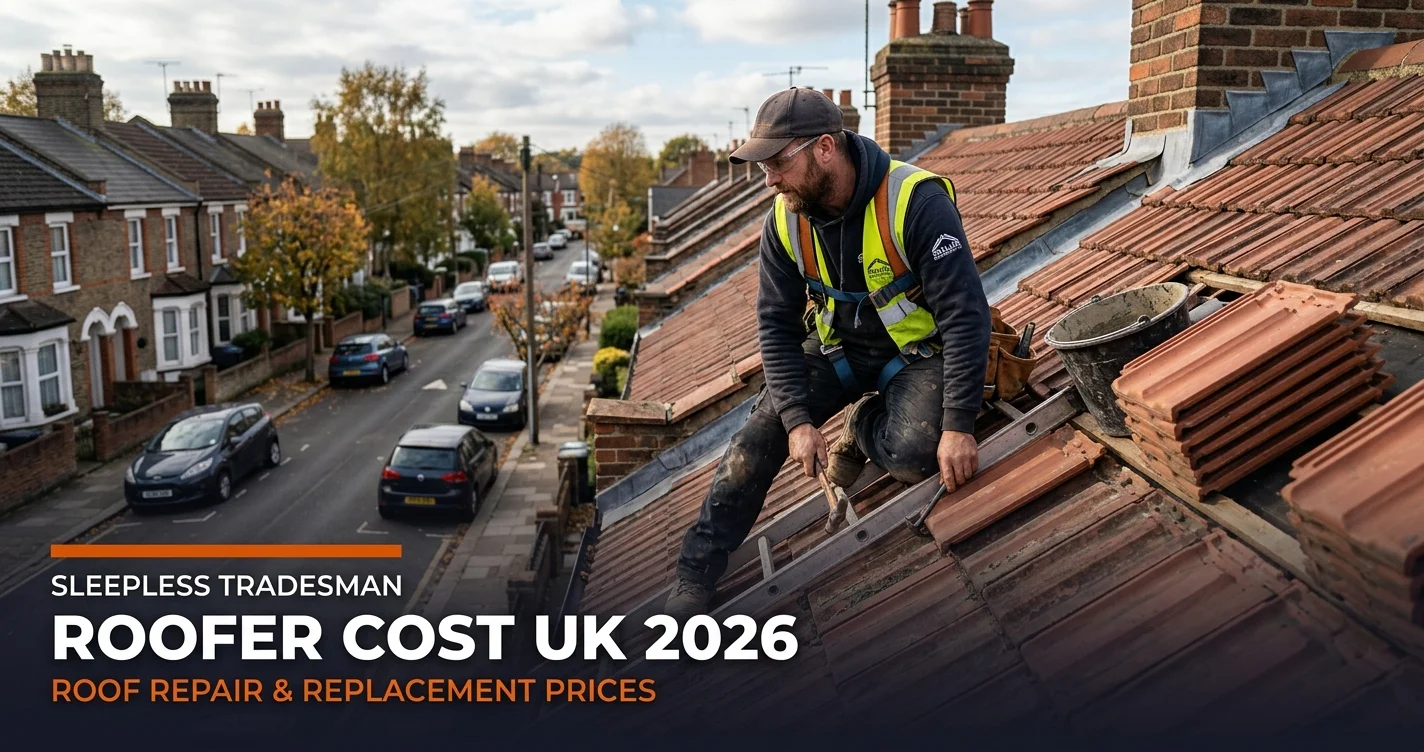
Roof Replacement Cost UK 2026
The table below summarises typical costs for common roof replacement and repair scenarios in the UK. All prices are indicative and include both materials and labour. Always obtain at least three written quotes for your specific property.
| Job Type | Typical Cost | Notes |
|---|---|---|
| Mid-terrace full re-roof (40–50m²) | £3,000–5,500 | Concrete tiles; scaffolding included |
| Semi-detached full re-roof (60–80m²) | £4,500–8,000 | Concrete or clay tiles typical |
| Detached full re-roof (100m²+) | £7,000–14,000 | Higher end for slate or complex roof |
| Flat roof replacement (felt) | £20–40/m² | Entry-level; 10–20 year lifespan |
| Flat roof replacement (EPDM rubber) | £30–50/m² | Good durability; 25–35 year lifespan |
| Flat roof replacement (GRP fibreglass) | £50–70/m² | Most popular; seamless; 25–40 years |
| Pitched roof: concrete tiles (per m²) | £20–40/m² | Most affordable pitched option |
| Pitched roof: clay tiles (per m²) | £30–60/m² | Traditional look; 60–100 year lifespan |
| Pitched roof: natural slate (per m²) | £40–80/m² | Premium; 80–150 year lifespan |
| Pitched roof: synthetic slate (per m²) | £25–45/m² | Slate appearance at lower cost |
| Re-ridging only | £500–1,500 | Repointing or replacing ridge tiles |
| Partial re-roof (one slope) | £1,000–4,000 | Depends on size and material |
| Velux window added during re-roof | £800–1,500 per window | Cost-effective when done alongside re-roof |
Prices are indicative averages for the UK (excluding London and South East). VAT at 20% applies to most roofing work. Costs can vary substantially depending on roof complexity, access, and local labour rates.
What Is Typically Included in a Roof Replacement Quote?
A comprehensive roof replacement quote from a reputable roofing contractor should include the following. If any of these are not mentioned, ask your roofer to clarify before signing off on the work.
- Stripping the existing roof covering: removing old tiles, slates, or felt and disposing of the waste appropriately
- Inspection and replacement of roof battens: old or rotten timber battens should be replaced before laying new tiles
- Breathable roofing membrane: a modern underlay installed beneath the tiles to prevent moisture ingress and improve thermal performance
- New roofing material: concrete tiles, clay tiles, natural slate, synthetic slate, or flat roofing system as agreed
- Ridge tiles and hip tiles: bedded and pointed with modern dry-fix mortar systems where applicable
- Flashing replacement: lead or alternative flashing around chimneys, dormers, valleys, and skylights
- Scaffolding: erected for the duration of the works and dismantled on completion — confirm this is included in the price
- Waste removal: all old roofing materials taken away and disposed of responsibly
- Guttering inspection: many roofers will check and refit guttering while scaffolding is up — ask if this is included
Factors That Affect Roof Replacement Cost
Several variables will push your roof replacement cost above or below the typical ranges. Understanding these factors helps you assess quotes critically and avoid being overcharged or undersold on quality.
- Roof size: the larger the roof area in square metres, the higher the total cost. Detached homes with hipped roofs or complex layouts will cost significantly more than a simple gable-ended terrace.
- Roofing material: material choice is the single biggest variable. Felt flat roofing is the cheapest option; natural slate is premium. For a 70m² pitched roof, the difference between concrete tiles and natural slate can be £3,000–5,000 in materials alone.
- Roof complexity: valleys, hips, dormers, chimneys, skylights, and soil pipes all add labour time and increase flashing requirements. A simple gable roof is the fastest and cheapest to re-cover.
- Structural condition: if rafters, joists, or fascia boards are rotten or damaged, these must be repaired before the new roof can be laid. This can add £500–2,000+ depending on the extent of the work.
- Access difficulty: properties with difficult access — tight alleyways, conservation area restrictions on scaffolding, or very steep pitches — require more scaffolding or specialist equipment and cost more to work on.
- Location: labour rates in London and the South East are substantially higher than in the North of England, Scotland, or Wales. See the regional variation table below for typical adjustments.
- Time of year: roofing contractors are busiest in spring and autumn. Booking in winter (when safe to do so) or during quieter periods may result in more competitive quotes.
- Additional extras: adding Velux or roof windows during a re-roof is cost-effective but adds £800–1,500 per window. Solar panel preparation, new chimneys, or lead valleys all increase the total.
Regional Cost Variation UK 2026
Roofing costs vary considerably across the UK, primarily due to differences in labour rates. The table below shows typical cost adjustments relative to the national average for a standard semi-detached re-roof (£4,500–8,000 nationally).
| Region | Typical Cost (semi-detached) | vs National Average |
|---|---|---|
| London | £5,850–11,200 | +30–40% |
| South East | £5,175–9,600 | +15–20% |
| East of England | £4,725–8,800 | +5–10% |
| Midlands | £4,500–8,000 | National average |
| Yorkshire & the Humber | £4,050–7,200 | –5–10% |
| North West | £4,050–7,200 | –5–10% |
| North East | £3,825–6,800 | –10–15% |
| Scotland | £3,825–6,800 | –10–15% |
| Wales | £3,825–6,800 | –10–15% |
Regional cost adjustments are approximate and reflect labour rate differentials. Material costs are broadly consistent across the UK, though transport costs can affect prices in rural areas. Remote locations in Scotland or Wales may attract additional call-out costs.
How to Find a Good Roofer in the UK
Roofing is one of the trades most associated with rogue traders and cowboy builders in the UK. Taking the right steps before you hire can save you thousands of pounds and protect your home from serious damage caused by poor workmanship.
Check for relevant accreditation:whilst there is no single mandatory licensing scheme for roofers in the UK, reputable contractors often belong to the National Federation of Roofing Contractors (NFRC) — the UK's largest roofing trade body. NFRC members are vetted for quality and adhere to the organisation's code of practice. You can search for an NFRC member at nfrc.co.uk. For flat roofing, look for contractors registered with the Single Ply Roofing Association (SPRA) or the Liquid Roofing & Waterproofing Association (LRWA) depending on the system specified.
Verify public liability insurance: any roofer working on your property should carry public liability insurance of at least £1 million. This protects you if they damage your property or injure a third party during the works. Ask to see the certificate before work begins — a reputable contractor will provide it without hesitation.
Get at least three written quotes: never accept a verbal quote or a single price. Ask at least three established local roofing companies for written quotations that itemise materials, labour, scaffolding, and waste disposal separately. Be wary of quotes that are significantly lower than the others — this often signals lower quality materials or the intention to overcharge for extras later.
Check independent reviews: look for reviews on Checkatrade, Which? Trusted Traders, Trustpilot, or Google. Pay attention to reviews specifically mentioning roofing work — some general builders review-stack across unrelated trades. Ask the contractor for references from recent local roof replacement jobs you can actually contact.
Three red flags to watch out for:
- Cold callers and doorstep sellers: a roofer who knocks on your door uninvited and claims to have "noticed damage while passing" is the single most common precursor to a roofing scam. Always source your own contractors independently.
- Demands for a large cash deposit upfront: reputable contractors may ask for a modest deposit (10–25%) on agreement, but demanding 50% or more before work starts — especially in cash — is a major warning sign. Never pay the full amount before the job is completed to your satisfaction.
- No written contract or vague specifications: if a roofer is reluctant to put the agreed scope of work, materials, price, and timeline in writing, do not proceed. A written contract protects both parties and is standard practice for any work over £1,000.
Frequently Asked Questions
How much does a new roof cost in the UK in 2026?
A full roof replacement in the UK typically costs £3,000–5,500 for a mid-terrace house (40–50m²), £4,500–8,000 for a semi-detached (60–80m²), and £7,000–14,000 for a detached property (100m²+). These figures include materials and labour but you should confirm whether scaffolding is included in your quote. Prices vary significantly by roofing material and region — London and the South East can be 20–40% higher than the national average.
How long does roof replacement take?
A pitched roof replacement typically takes 3–10 days depending on the size of the property and the complexity of the roof. A flat roof replacement is generally quicker, usually completed in 2–5 days. Larger or more complex roofs — those with multiple valleys, dormers, or chimneys — will take longer. Wet or very cold weather can delay work, so scheduling in spring or summer when conditions are more favourable is advisable.
Do I need planning permission to replace my roof?
For a like-for-like replacement — using the same or similar materials — planning permission is not typically required in England, Scotland, or Wales. This falls under permitted development rights. However, if your property is in a conservation area or is a listed building, you may need consent before making changes, even for repairs or replacements. You should also check with your local authority if you intend to change the roofline, add dormer windows, or alter the roof profile significantly.
What roofing material lasts longest in the UK?
Natural Welsh or Spanish slate is widely regarded as the most durable roofing material available in the UK, with lifespans of 80–150 years or more when correctly installed. Traditional clay tiles are also extremely long-lasting at 60–100 years. Concrete tiles offer a more affordable alternative at 40–60 years, whilst GRP fibreglass is the most durable flat roofing material, lasting 25–40 years. Cheaper felt flat roofing typically needs replacing after 10–20 years, making it a false economy on larger projects.
How do I know if I need a new roof vs repairs?
You likely need a full replacement rather than repairs if your roof is more than 20–25 years old (for concrete tiles or felt flat roofing), if you have widespread cracked, slipped, or missing tiles across multiple areas, or if you can see daylight through the roof boards when in the loft. A localised leak caused by a single broken tile or slipped flashing is typically a repair. If a roofer recommends replacement, always get a second opinion — a reputable contractor should be able to explain precisely why repair is not a viable option.
Is scaffolding always needed for roof work?
Scaffolding is required by law under the Work at Height Regulations 2005 for most pitched roof work in the UK, as it provides a safe working platform for roofers. For full replacements, scaffolding is almost always necessary and should be included in your quote — always confirm this before accepting. For flat roofs and some minor repairs on single-storey extensions, a roofer may be able to work safely from a ladder with proper securing, but this should comply with current health and safety guidance. Scaffolding for a typical house typically adds £600–1,200 to the overall cost if quoted separately.
Related Cost Guides
Get an Instant Cost Estimate
Describe your project to our AI and get an itemised cost estimate instantly.
Get a Free Estimate