How Much Does Scaffolding Cost in the UK? [2026]
Written by Tom Ellis · Senior Trades Editor
Last updated: July 2026
Last updated: July 2026 · United Kingdom
Quick Answer
Last updated: July 2026 · United Kingdom
Scaffolding in the UK costs £600–£2,500 per week depending on the size of your property, with most domestic jobs priced as an all-in package. A typical 4-week roof job on a semi-detached house will cost £3,200–£5,000 total, including erection, hire, and dismantling. Extras such as a chimney scaffold or crash deck add £200–£500 each.
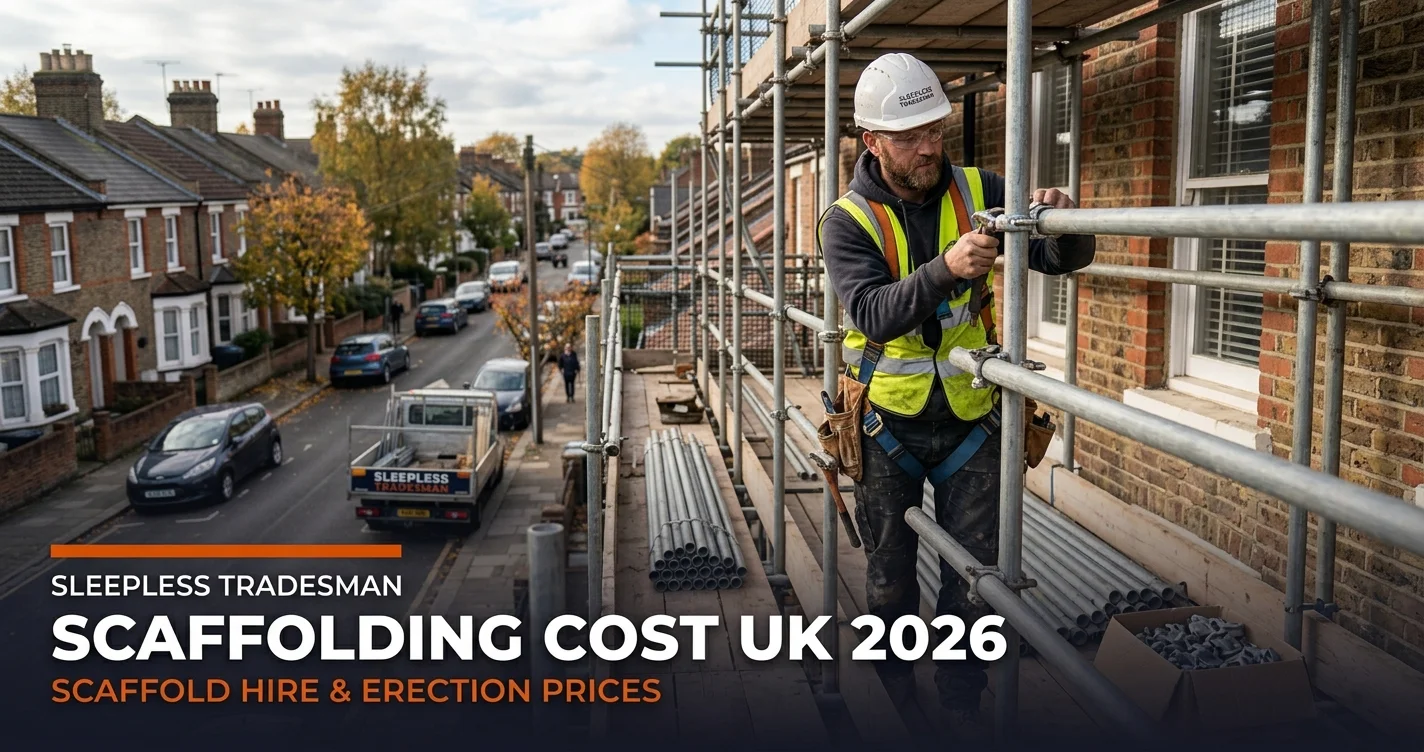
Scaffolding Cost Summary UK 2026
| Scaffold Type / Scenario | Weekly Hire Rate | Typical Total (4 weeks) |
|---|---|---|
| Mid-terrace house (2-storey) | £600–£900 | £2,400–£3,600 |
| Semi-detached house (2-storey) | £800–£1,200 | £3,200–£5,000 |
| Detached house (2-storey) | £1,000–£2,500 | £4,000–£10,000 |
| Small extension scaffold | £400–£800 | £1,600–£3,200 |
| Chimney access addition | — | +£200–£500 |
| Crash deck (protective boards) | — | +£200–£400 |
| Erect and dismantle labour | — | Included or +£150–£350 |
| Overage (per week over agreed period) | £100–£300 | — |
| Scaffold tower hire (DIY, per bay) | £50–£100 | £200–£400 |
Prices are indicative national averages for 2026. London and the South East typically cost 15–40% more. Most quotes include a minimum hire period of 2–4 weeks. Always obtain at least 3 written quotes.
What’s Included in a Scaffolding Quote?
A professional scaffolding quote should be broken down clearly so you know exactly what you are paying for. When comparing quotes, check that all of the following are covered:
- Erection labour: The cost of the scaffolders’ time to build the structure on site, typically half a day to a full day for a domestic property.
- Tube, fittings, and boards: All steel tubes, couplers, base plates, and timber or aluminium boards used in the structure.
- Toe boards and guard rails: Safety rails at working platform level — mandatory under Working at Height Regulations 2005.
- Agreed hire period: Normally 2–4 weeks minimum; make sure the quoted period matches your project timeline.
- Dismantling and collection: Most reputable companies include this; some budget suppliers charge separately (£150–£350 extra).
- Public liability insurance: Your contractor’s cover should extend to the scaffold while it is erected on your property.
- Highways licence (if required): If the scaffold crosses a pavement, this may be arranged by the contractor or billed as a pass-through cost of £50–£200.
Extras that are often quoted separately include chimney access ladders (£200–£500), crash decks to protect conservatories or extensions below the working area (£200–£400), and sheeting or netting for wind protection or containment of debris.
Factors That Affect Scaffolding Cost
- Property size and height: The more bays and lifts required to surround your property, the more tube and fittings are needed and the longer erection takes. A large detached house can require twice the materials of a terrace.
- Access difficulty: Narrow side passages, sloping ground, or obstacles such as conservatories or outbuildings all increase complexity and labour time, pushing costs towards the upper end of the range.
- Hire duration: Most companies price on a minimum 2–4 week hire. Projects that overrun attract weekly overage charges of £100–£300, so accurate project planning pays dividends.
- Type of work: A simple roof replacement requires scaffold on one or two elevations; full external re-rendering or brick repointing of a detached house may need scaffold on all four sides, significantly increasing cost.
- Chimney or dormer access: Any structure that projects above the main roof line requires additional birdcage or independent scaffold, typically adding £200–£500 to the package.
- Crash deck requirement: If there is a conservatory, extension flat roof, or public walkway beneath the working area, protective boards (a crash deck) are a legal requirement and add £200–£400.
- Location: Labour and transport costs mean scaffolding is considerably more expensive in London and the South East than in the North of England, Scotland, or Wales — see the regional table below.
- Time of year: Demand peaks in spring and summer when roof and render work is most common. Booking in autumn or winter may secure a better price, but weather can cause project delays.
Regional Cost Variation UK 2026
Scaffolding costs vary significantly across the UK, primarily driven by regional labour rates and travel costs. The figures below use the national average weekly hire cost for a semi-detached house (approximately £1,000/week) as a benchmark.
| Region | Typical Weekly Rate (Semi-Detached) | vs National Average |
|---|---|---|
| London | £1,050–£1,680 | +30–40% |
| South East | £920–£1,440 | +15–20% |
| East of England | £840–£1,320 | +5–10% |
| Midlands | £800–£1,200 | National average |
| Yorkshire & Humber | £720–£1,140 | −5–10% |
| North West | £720–£1,140 | −5–10% |
| North East | £680–£1,020 | −10–15% |
| Scotland | £680–£1,020 | −10–15% |
| Wales | £680–£1,020 | −10–15% |
Regional averages based on 2026 market data. Individual quotes may vary based on project complexity and contractor availability.
How to Find a Good Scaffolder in the UK
Scaffolding is safety-critical infrastructure. Poorly erected scaffold has caused serious injuries and fatalities in the UK — choosing a competent, properly insured contractor is not optional. Here is what to look for:
- NASC membership: The National Access and Scaffolding Confederation (nasc.org.uk) is the premier trade body for the industry. Member firms are regularly audited against rigorous safety standards and must employ CISRS (Construction Industry Scaffolders Record Scheme) card-holding operatives. Always check NASC membership before hiring.
- CISRS cards: Ask to see the CISRS cards of the scaffolders who will be working on your property. Cards are colour-coded by grade — a Scaffolder card (blue) or Advanced Scaffolder card (red) confirms formal competence.
- Public liability insurance: Ask for evidence of public liability insurance with a minimum cover of £1 million, preferably £2 million or more for domestic projects. Request a copy of the current certificate.
- Written quote with full breakdown: A reputable scaffolder will provide a written quotation detailing the hire period, what is included, and any circumstances that could lead to additional charges.
- At least 3 quotes: Scaffolding prices vary considerably between companies. Getting three written quotes gives you a realistic market rate and negotiating leverage.
- Check reviews: Look for the company on Checkatrade, Which? Trusted Traders, or Google Reviews. Look for recent reviews that mention specific projects similar to yours.
Three red flags to avoid:
- Cash-only, quote only verbal: Legitimate scaffolding companies provide written quotes and receipts. An insistence on cash with no paperwork suggests the company is uninsured or working off the books.
- No CISRS cards or NASC membership: Scaffolding erected by untrained individuals is a genuine safety hazard. If a company cannot produce evidence of trained operatives, walk away.
- Unusually low price with no detail: A quote substantially lower than others — with no explanation of what is included — often means corners will be cut on materials, safety boards, or toe boards, leaving you with non-compliant scaffold and potential liability.
Frequently Asked Questions
How much does scaffolding cost in the UK in 2026?
Scaffolding hire in the UK typically costs £600–£900 per week for a standard mid-terrace house, £800–£1,200 per week for a semi-detached, and £1,000–£2,500 per week for a detached property. Most contractors quote a total package price covering erection, the agreed hire period, and dismantling. A typical 4-week roof job on a semi-detached will cost between £3,200 and £5,000 all-in, including any extras such as a crash deck or chimney access. Prices are higher in London and the South East and lower in the North of England, Scotland, and Wales.
How long can I hire scaffolding for?
Most scaffolding companies impose a minimum hire period of 2 to 4 weeks, as shorter periods are not commercially viable given the labour cost of erecting and dismantling the structure. Beyond the agreed hire period you will typically be charged an overage rate of £100–£300 per week until the scaffold is collected. If your project is delayed — for example by bad weather or a material delivery problem — contact your scaffolder promptly to agree a formal extension, as overage charges can accumulate quickly. Most companies will accommodate extensions with reasonable notice if given early enough.
Is scaffolding always needed for roof work?
Working at Height Regulations 2005 require that any work above 2 metres uses appropriate fall-protection measures, which in practice means full tube-and-fitting scaffold for most domestic roof repairs or replacements. Some very minor repairs to a single ridge tile may be carried out from a properly footed ladder with a standoff bracket, but any contractor who proposes re-roofing an entire pitch from a ladder is working unsafely and potentially unlawfully. For flat-roof extensions where edge protection is straightforward, a proprietary edge-protection system may replace full scaffold, but a competent contractor will always assess the risk before advising on the most appropriate access solution.
Does scaffolding require planning permission?
In most cases, temporary domestic scaffolding does not require planning permission, as it is considered permitted development. However, if the scaffold encroaches onto a public pavement or highway — which is common on terraced streets — you will need a licence from your local council, often called a Highways Licence or Section 169 licence, which typically costs £50–£200 and takes 5–10 working days to obtain. Your scaffolding contractor usually arranges this on your behalf and passes the cost through to you; confirm this is included before work begins. Conservation area or listed building restrictions may impose additional conditions in some areas.
What is NASC and why does it matter?
NASC stands for the National Access and Scaffolding Confederation, the UK’s leading trade body for the scaffolding industry. Member companies must meet strict health and safety standards, carry adequate public liability insurance, employ trained CISRS card-holding operatives, and submit to regular independent audits. Hiring a NASC member significantly reduces your risk of receiving unsafe, non-compliant scaffold and gives you recourse if something goes wrong. You can verify membership and find accredited local contractors through the NASC website at nasc.org.uk.
Can I hire scaffolding myself as a homeowner?
Yes — homeowners can hire scaffold towers directly from tool-hire companies at roughly £50–£100 per bay per week, which are suitable for low-level work such as painting fascias or clearing gutters on a single-storey extension. However, full tube-and-fitting scaffold for roof-height work must be erected by a competent, preferably NASC-member scaffolding contractor; attempting to self-erect roof-level scaffold without training is extremely dangerous and may invalidate your home insurance if an accident or structural damage occurs. Always use a CISRS-certified scaffolder for anything above single-storey height.
Related Cost Guides
Get an Instant Cost Estimate
Describe your project to our AI and get an itemised cost estimate instantly.
Get a Free Estimate